Zodiac nursery ideas
A zodiac nursery can be as simple as one star print or as full as a room that carries the baby's whole sky. The choice depends on what you know: the sign, the exact birth time, or only a due date. Here is how to choose, what colours to use, and how to make a room that grows with the child.
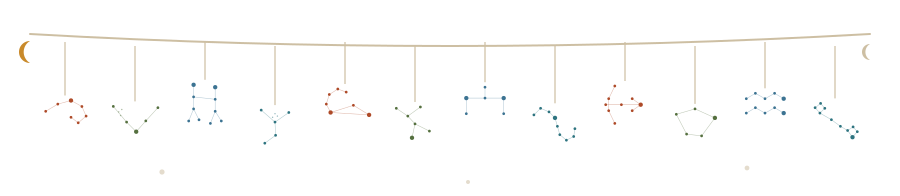
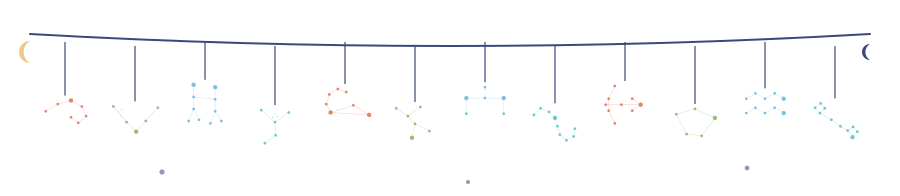 Imagem: zodiac.baby
There are four main ways to make a zodiac nursery. Constellation art shows the real star pattern of the baby’s sign. Glyph art uses the sign’s written symbol. A birth-sky print shows the sky at the exact moment of birth. A general starry theme uses Moon, stars and night sky without naming one sign.
If the baby is already here and you know the sign, choose constellation or glyph art. If you also know the exact birth time and place, a birth-sky print is the most personal of all. If the baby is not born yet, start with a starry theme or a season theme, and add the sign after the birth. Then choose colours by element, keep the room calm, and plan for it to grow.
The four kinds of zodiac nursery at a glance
| Kind | What it shows | What you need to know | Best for | How it grows |
|---|---|---|---|---|
| Constellation art | The sign’s stars, joined into their pattern | Only the sign | A soft, real-sky feel | Very well: a child can later find the same stars outside |
| Glyph art | The sign’s symbol, often large | Only the sign | A bold, clean, modern room | Very well: the glyph looks just as good at seven |
| Birth-sky print | A chart wheel or star map for the moment of birth | Date, exact time and place of birth | A one of a kind keepsake | Becomes more meaningful as the child learns their chart |
| General starry theme | Moon, stars, night sky, no single sign | Nothing at all | Before the birth, or for a shared room | Easy to add the sign later |
You can mix them. Many of the loveliest rooms use a general starry theme for the walls and one sign piece as the centre.
Constellation art: the real stars
The twelve signs take their names from twelve star patterns that lie along the ecliptic, the path the Sun seems to travel across the sky through the year. These are real patterns in the real sky. Astronomers today recognise 88 constellations in all, and the zodiac ones are among the oldest named.
A constellation print joins the sign’s stars with fine lines. It is the gentlest choice, because it looks like a quiet piece of the night sky. It also teaches something true: later, on a clear night, you can take the child outside and find the same stars.
Some zodiac patterns are bold and easy to spot. Leo has the Sickle, a backwards question mark of stars with Regulus at its base. Sagittarius has the Teapot. Scorpius, the scorpion, has the red star Antares at its heart. Taurus has the bright orange Aldebaran and the little cluster of the Pleiades. Gemini has the twin stars Castor and Pollux. Others are faint and small: Cancer and Aries are quiet patterns, so artists often draw the crab or the ram around them. Either way works.
Tip: check that the print really shows your baby’s sign. Star patterns are easy to mix up, and a wrong one is hard to unsee once you notice.
Glyph art: the symbol
Each sign has a glyph, a short written symbol. The Aries glyph is the ram’s horns. The Taurus glyph is a circle with horns on top. The Cancer glyph is two curls, like folded claws. The Aquarius glyph is two zigzag waves. The twelve glyphs are standard characters in the Unicode list of computer symbols, from U+2648 for Aries to U+2653 for Pisces, so any printer, painter or embroiderer can set them cleanly.
A glyph is the boldest choice. It reads clearly from across the room and suits a clean, modern style. It also grows up well, because a large glyph looks just as right in the room of a school child as in the room of a baby. A glyph with the baby’s name and birth date makes a strong centre piece above a chest of drawers or a reading chair.
Birth-sky print: the sky at the moment of birth
A birth-sky print is the most personal piece of all, because no other baby has the same one. There are two kinds, and they show different things.
- A chart wheel is the astrologer’s picture. It shows the twelve signs in a circle and places the Sun, Moon, planets and rising sign where they were at the moment of birth. This is the baby’s birth chart, the map astrology reads.
- A star map is the astronomer’s picture. It shows the stars as they would have looked overhead from the place of birth, at the time of birth.
Both need the date, the exact time and the place. The Moon changes sign every two to three days, and the rising sign, the sign coming up over the eastern horizon, changes roughly every two hours. A guess at the time can give the wrong rising sign. To understand what a chart wheel shows, see how to read a child’s birth chart and sun, moon and rising.
One small point on privacy. A print with the baby’s full name, exact time and place of birth is a lovely thing on the wall. It is less lovely in a public photo online. If you share pictures of the nursery, keep that print out of the frame or blur the details.
A general starry theme
A starry theme uses the Moon, stars and night sky without naming one sign. Think a crescent Moon on one wall, a scatter of small stars, a deep blue or soft grey, a cloud or two. It is calm, it suits any baby, and it works well for a shared room with an older brother or sister of a different sign.
It is also the best place to start if the baby is not born yet.
When the baby is not born yet
A due date is an estimate. Pregnancy normally lasts from 37 to 42 weeks, so the real birthday can fall anywhere in a window of about five weeks. A sign lasts about a month. That means almost every due date sits close to two signs, and sometimes three.
There is a second catch. Neighbouring signs never share an element. The order always runs fire, earth, air, water, then fire again. So a baby due near a boundary could be fire or earth, or air or water. An element theme picked before the birth is often a coin toss.
Here are three ways round it.
Choose a starry base and add the sign later
Paint and furnish the room with a general starry theme. Leave one frame, one shelf or one space above the cot wall empty. After the birth, add the sign piece: the constellation, the glyph or the birth-sky print. The room is finished before the baby comes, and it becomes theirs after.
Choose the season
The zodiac is built on the seasons. The sign of Aries begins at the March equinox, Cancer at the June solstice, Libra at the September equinox and Capricorn at the December solstice. Each season holds three signs, one of each of three elements, so a season theme fits the baby whichever sign they turn out to be.
| Season (northern hemisphere) | Signs | Feel for the room |
|---|---|---|
| Spring | Aries, Taurus, Gemini | Fresh greens, blossom, new shoots, birdsong |
| Summer | Cancer, Leo, Virgo | Warm sun, the sea, gold fields, long evenings |
| Autumn | Libra, Scorpio, Sagittarius | Soft pinks to deep reds, falling leaves, early stars |
| Winter | Capricorn, Aquarius, Pisces | Clear cold skies, silver, snow, deep blues |
In the southern hemisphere the seasons are the other way round, so a December baby is a summer baby there. Use the season you will actually be living in when the baby comes.
Choose the two likely signs
If the due date sits between two signs, you can honour both lightly: two small constellation prints side by side, with a plan to move one to another room or into a memory box after the birth. It feels a little like waiting for the baby to choose.
For a baby born very near the changeover, the exact time decides the sign. See born on the cusp.
Colours by element
Colour is where the element comes into the room most easily. Astrology sorts the twelve signs into four elements, and each element has its own feel. Read more in the four elements before the twelve signs.
| Element | Signs | Palette | How it feels |
|---|---|---|---|
| Fire | Aries, Leo, Sagittarius | Warm reds, gold, amber, sunny yellow, deep purple, with cream | Warm and bright, like a fire glowing |
| Earth | Taurus, Virgo, Capricorn | Sage and forest green, oatmeal, wheat, warm brown, slate | Solid and calm, like a garden or a stone wall |
| Air | Gemini, Libra, Aquarius | Pale yellow, soft pink, pale blue, silver grey, turquoise | Light and open, like a spring sky |
| Water | Cancer, Scorpio, Pisces | Pearl white, sea green, aqua, lavender, deep plum | Soft and deep, like the sea at evening |
A nursery is a place for rest, so for walls, use the softer end of the palette and save the strong colours for small things: a print, a cushion, a rug, a toy box. A fire nursery does not need red walls. It needs one warm, glowing piece in a calm room.
Colours for each sign
| Sign | Colours |
|---|---|
| Aries | Red, scarlet, crimson, set off with white |
| Taurus | Soft green, rose pink, cream, warm earth browns |
| Gemini | Yellow first, with soft silver grey |
| Cancer | Silver, pearl white, cream, pale sea green, soft moonlit blue |
| Leo | Gold, orange, sunny yellow, warm amber |
| Virgo | Navy blue, sage green, wheat gold, oatmeal, crisp white |
| Libra | Soft pink and pale blue |
| Scorpio | Deep red, wine, black, dark plum, smoky grey |
| Sagittarius | Purple, royal blue, indigo, turquoise |
| Capricorn | Charcoal, slate grey, deep brown, forest green, black |
| Aquarius | Electric blue and turquoise, with silver |
| Pisces | Sea green, aqua, lavender, soft violet, misty silver grey |
The darker sign colours, such as Scorpio’s black and wine or Capricorn’s charcoal, are best as accents. One deep plum velvet frame in a pale room carries Scorpio beautifully.
Ideas by element
A fire nursery: warm and bright
Fire children are lively and quick. The room should give them warmth and a sense of light without too much to rev them up at bedtime.
- A gold or amber constellation print, the brightest thing on the wall.
- A sun on the ceiling for daytime and a soft warm lamp for evening.
- Wooden toys in warm tones, with room on the floor to move.
- For Sagittarius, a map or a picture of far places. For Leo, a lion. For Aries, a ram, and a book of firsts on the shelf.
An earth nursery: solid and calm
Earth children trust what they can touch. The room should feel steady and real.
- Natural textures: wood, wool, linen, cotton, woven baskets.
- Green plants, painted or printed on the wall.
- A constellation print in a plain wooden frame.
- For Taurus, the softest blanket you can find for the chair. For Virgo, neat shelves and labelled baskets. For Capricorn, a mountain picture and one good, sturdy piece of furniture.
An air nursery: light and open
Air children love things to look at and listen to. The room should feel airy and interesting.
- Pale walls, light curtains, a window kept clear so the sky shows.
- A mobile with stars or clouds that turns slowly in the air from the window.
- Books face out on a low shelf, so there is always something new to see.
- For Gemini, a pair of matching prints, the twins. For Libra, a beautiful, balanced wall of frames. For Aquarius, something unusual: a hand drawn star map, an odd lamp, a print nobody else has.
A water nursery: soft and deep
Water children feel everything in a room. The space should be gentle and quiet.
- Soft light that can be turned low.
- Curves and soft fabrics, waves, shells, the Moon.
- A cosy corner for being held: a chair, a footstool, a blanket.
- For Cancer, a crescent Moon, since the Moon rules the sign, and family photos close by. For Scorpio, deep colour and a calm, private feel. For Pisces, two fish, the sea, watery blues and lilacs.
One idea for each sign
| Sign | One nursery idea |
|---|---|
| Aries | A bold red ram’s horn glyph above the door, so the room says “go” |
| Taurus | A cream and green room with the Pleiades print, and the softest chair in the house |
| Gemini | Two matching prints of the twins, Castor and Pollux, side by side |
| Cancer | A silver crescent Moon on a pale sea green wall, with family photos below |
| Leo | A gold Sickle of stars, with Regulus marked, as the centre of the room |
| Virgo | Spica, the ear of grain, in wheat gold on navy, above neat open shelves |
| Libra | A balanced pair of frames in pink and pale blue, the scales between them |
| Scorpio | The scorpion’s stars with Antares in deep red, on a pale wall with plum accents |
| Sagittarius | The Teapot in purple, with an old style map of the world beside it |
| Capricorn | The sea goat in charcoal on cream, with a mountain picture for the climb |
| Aquarius | Two zigzag waves in electric blue, and a star map drawn by hand |
| Pisces | Two fish swimming in a circle in sea green and lavender, waves below |
For more on each sign, start at the twelve signs. For gifts that carry the sign, see zodiac baby gifts.
Add the Moon and the rising sign
The Sun sign gives the room its theme. Two other parts of the chart can add a quiet second layer, if you know the birth time.
The Moon sign shows what the child needs underneath, and in a room made for sleep, it is worth listening to. A water Moon child may love soft light and closeness more than a bright Sun sign room would suggest. An air Moon child may settle better with something gentle to look at. You can echo the Moon with one small thing: a Moon print in that sign’s colour, or a cushion on the chair. Each Moon is read in the twelve Moons.
The rising sign is the face a child shows the world. It can guide the first thing you see as you walk in. Read more in the rising sign in children.
If the Sun and Moon fall in the same sign, the whole room can lean into one sign with confidence. See double signs.
Make it grow with the child
A nursery is a baby’s room for a short time and a child’s room for years. Plan for that.
The first year. Keep it calm and simple. One or two sign pieces, soft colours, a dim light for the night. One clear star print is plenty.
The toddler years. Bring the stars down to the child’s height. A low shelf with a picture book about the night sky. A small framed print of their sign they can point to. Start saying it: “That’s your sign. Those are your stars.”
Three to six. Let the child join in. They can choose a colour, help hang a print, or draw their own constellation by joining dots. This is the age to go outside on a clear night and look for the real stars.
School age. Give them the full story. A birth-sky print, if you have one, starts to make sense now. Keep the glyph or constellation, which grows up well, and let the child add things of their own. By seven, many children want a say in their room, and a zodiac theme gives them something to build on rather than something to outgrow.
Choose a few pieces that will last: a good frame, a quality print, a well made shelf. Keep the babyish parts, such as a mobile or a cot set, easy to swap. The sign stays. The style can change around it.
One word on safety
Decorations, mobiles, cushions, wall hangings and small star stickers stay out of the baby’s reach and out of the cot. Keep cords from blinds, lights and string decorations tied up and well away. The sleep space itself is kept clear.
What to avoid
- Too much at once. Twelve signs, a moon, planets, clouds and rainbows in one room is a lot for a small person. Choose one theme and let it breathe.
- The wrong sign on the wall. Check the dates in the twelve signs, and for a baby born near a boundary, check the exact time before ordering anything personalised.
- Dark walls everywhere. A deep navy night sky can be lovely, but in a small room it can feel heavy. A dark ceiling or one dark wall is often enough.
- Putting the exact birth time and place on show online. Keep the birth-sky details for the family.
- Buying everything before the birth. Leave room for the baby’s sign to arrive.
A room that carries the sky
The best zodiac nursery is not the busiest. It is the one where a small person, lying in a quiet room, is surrounded by something true about themselves: their stars, their colours, the season they arrived in. Start simple, add the sign when it comes, and let the room grow up as they do.
Sources and references
- Wikipedia: IAU designated constellations, for the 88 constellations recognised today.
- Wikipedia: Ecliptic, on the path of the Sun and the zodiac constellations along it.
- Wikipedia: Tropical zodiac, on the sign of Aries beginning at the March equinox.
- Unicode Consortium: Miscellaneous Symbols chart, for the twelve zodiac glyphs, U+2648 to U+2653.
- NHS: Due date calculator, on pregnancy normally lasting 37 to 42 weeks.
- NHS: Reduce the risk of sudden infant death syndrome, on keeping the cot free of toys, blankets and pillows.
- NHS: Baby and toddler safety, on blind cords and small objects.